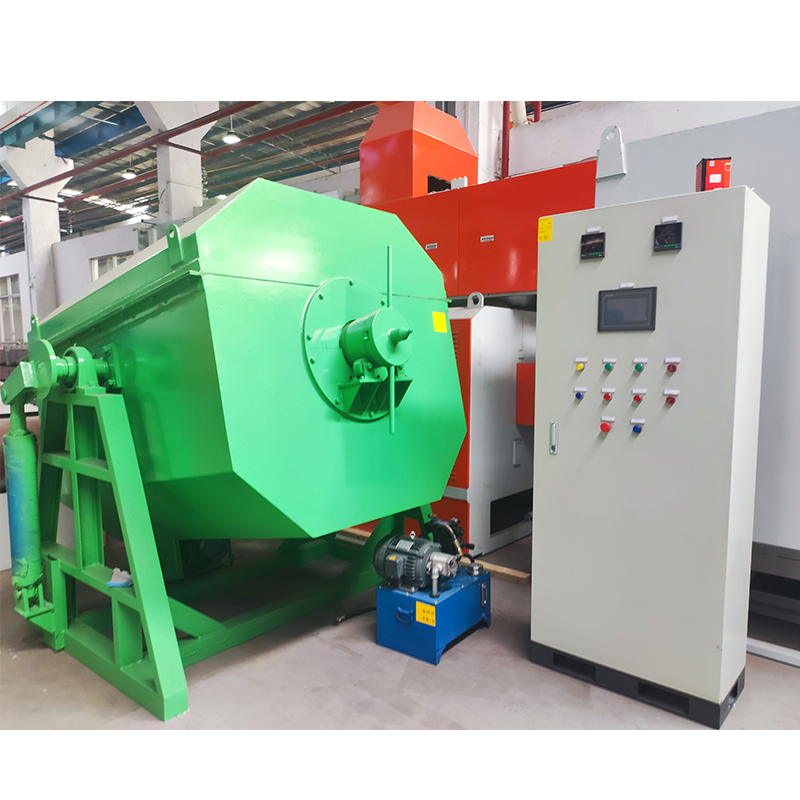


Analysis of the Advantages and Disadvantages of Carburizing rotary Furnace
Jan. 13, 2026
As a cycle operation type resistance furnace, the carburizing rotary furnace has remarkable advantages:
Firstly, it has strong sealing performance and uniform temperature (±2℃), ensuring stable carburizing quality of the workpiece, especially suitable for large-scale and small-sized heat treatment;
Secondly, it has high thermal efficiency (50-80%), low energy consumption, simple operation, and can integrate multiple processes such as gas carburizing, carbon-nitrogen co-carburizing, and smooth quenching, reducing equipment switching costs;
Thirdly, it has a compact structure, achieving uniform heating of the workpiece through the rotation of the rotary, avoiding local overheating or underheating, and supporting dense loading to improve production efficiency.
In terms of disadvantages:
Firstly, the cycle operation mode leads to insufficient production continuity and limited single furnace processing capacity, making it difficult to meet the requirements of ultra-large-scale production;
Secondly, the equipment has high sealing requirements, and the sealing parts are prone to wear after long-term use, requiring regular maintenance; otherwise, it may cause air leakage or fluctuations in the carburizing atmosphere;
Thirdly, compared with continuous carburizing furnaces, it has a lower degree of automation, with more manual intervention, and is highly dependent on the experience of the operators.