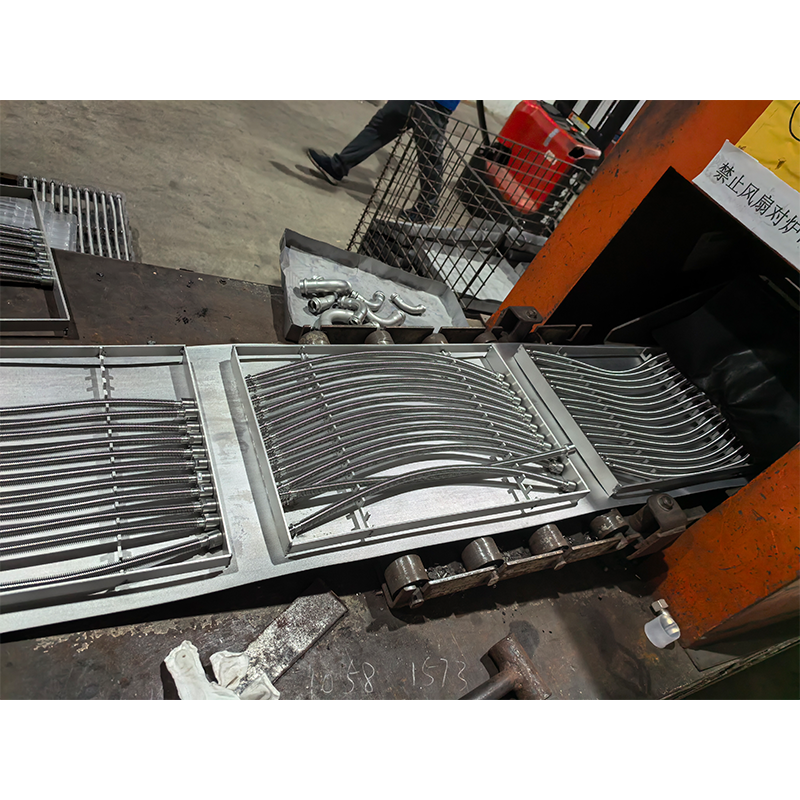


What kind of heat treatment is required for stainless steel condenser tubes
Feb. 09, 2026
Stainless steel liquid cooling tubes need to select the heat treatment process based on the material and performance requirements. The common types and their functions are as follows:
Solution treatment: Heat the stainless steel to 1050-1150℃ and then rapidly cool it (such as water quenching) to allow the carbides to fully dissolve in the austenite and remain at room temperature. This process can eliminate work hardening, restore corrosion resistance, and is particularly suitable for austenitic stainless steel (such as 304, 316), which can dissolve the Cr₂₃C₆ carbides formed during welding and prevent intergranular chromium deficiency corrosion risks, while also uniformly organizing the structure to ensure dimensional stability.
Stabilization treatment: For austenitic stainless steel containing titanium (Ti) or niobium (Nb) (such as 321, 347), heat it to 850-880℃ after solution treatment and then hold it and cool it slowly. This process promotes the combination of Ti/Nb with carbon to form stable compounds (TiC, NbC), fundamentally avoiding the formation of Cr₂₃C₆ from chromium and carbon, further eliminating residual stress and preventing the secondary precipitation of carbides, and is suitable for liquid cooling tubes that operate for a long time at 400-600℃.
Strain relief treatment: Heat to 250-400℃ (for austenitic stainless steel) or 600-800℃ (for ferritic stainless steel) and hold it for a while before slowly cooling down to reduce residual stress generated during welding or cold processing, preventing the liquid cooling tubes from deforming or cracking due to stress release during operation, and reducing the risk of stress corrosion.
Special process supplements: If the liquid cooling tubes need high strength, precipitation hardening type stainless steel (such as 17-4PH) requires aging treatment (heating to 480-620℃ and then cooling slowly) to precipitate strengthening phases; for tube materials with high surface quality, bright annealing (heating in a hydrogen atmosphere to 700-900℃ and then slowly cooling down) can be used to avoid oxidation and decarburization and reduce dimensional loss.