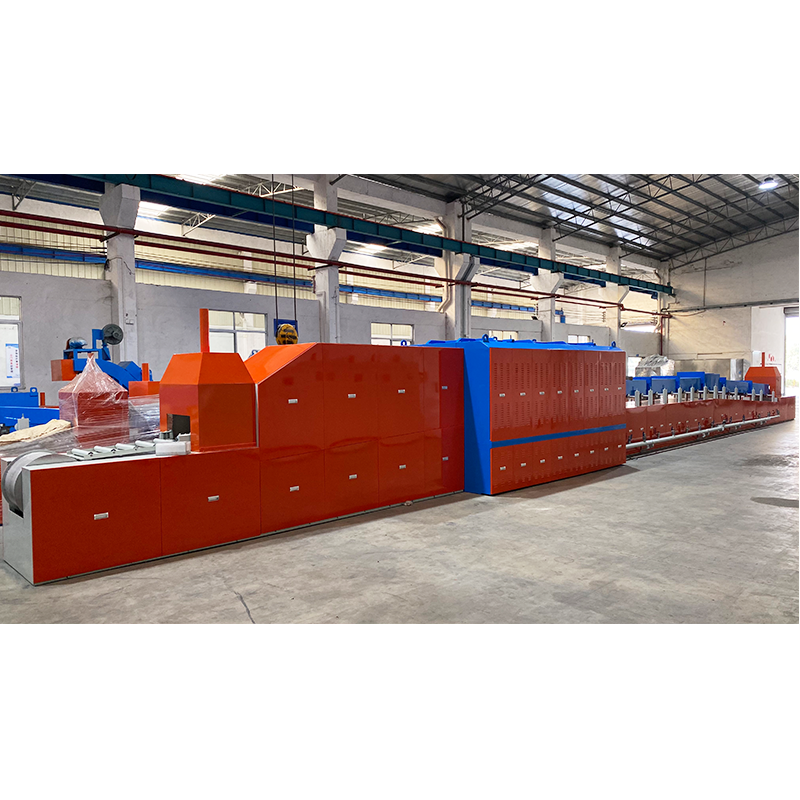


Common Faults and Solutions of Continuous Heat Treatment Furnaces
Dec. 22, 2025
Failure | Reason | Solution |
The workpiece surface is not bright | The new equipment has just been turned on and its surface is gray Not enough holding time, too many impurities | Run the empty furnace several times Use clean waste to remove impurities from the furnace |
The transmission speed is too fast, the surface is yellow | Reduce transfer speed | |
Low temperature | Raise the temperature appropriately | |
The workpiece loading density is high | Reduce workpiece loading density | |
Air flow is small or unstable | Increase the air flow or increase the inlet and outlet wind protection | |
Ammonia decomposition furnace operating temperature is low, Catalytic cracking is not good Greenish appearance | Increase the operating temperature of ammonia decomposition furnace
| |
Cracking tank catalyst aging | Replace the catalyst in the cracking furnace
| |
Air leakage at the furnace tube or the connection between the furnace tube and the water jacket | Strengthen the seal or replace the furnace tube | |
Furnace clogging | Work placement is too high or too wide | Decrease display height or width |
Furnace tube/tank vertical deformation | Flatten the bottom plate of the furnace and the top of the furnace tube | |
The steel belt is too long | Adjust the tension device in time | |
Furnace tube / pot lateral deformation | Furnace tube/pot replacement | |
The heating zone has not current
| Over temperature alarm | Increase the set temperature (during heating up) |
Thermal inertia overtemperature often occurs when the temperature rises | Replace thermocouple | |
SCR damage | Replace Power Regulator | |
Blown fuse | Replace fuse core | |
Thyristor does not conduct | Replace Power Regulator | |
The thyristor cannot be triggered | Replace Power Regulator | |
Temperature control meter, no output signal | Replace Power Regulator | |
Poor line contact | Check all connections in the heating circuit | |
Heating wire break | Replace heating wire | |
Furnace blast/flameout | The inlet and outlet enter the air/products run too fast, the air cannot be discharged | The inlet and outlet to prevent air from entering / product running speed slowed down |