


What kind of heat treatment is required for the bearings
Feb. 26, 2026
Bearings, as key components in mechanical transmission, have their performance (such as hardness, wear resistance, and fatigue resistance) directly affecting the service life and reliability of equipment. Heat treatment is the core process for enhancing the performance of bearings. By heating, holding, and cooling, the internal microstructure of the material is altered to optimize mechanical properties. The following are common heat treatment processes for bearings and their functions:
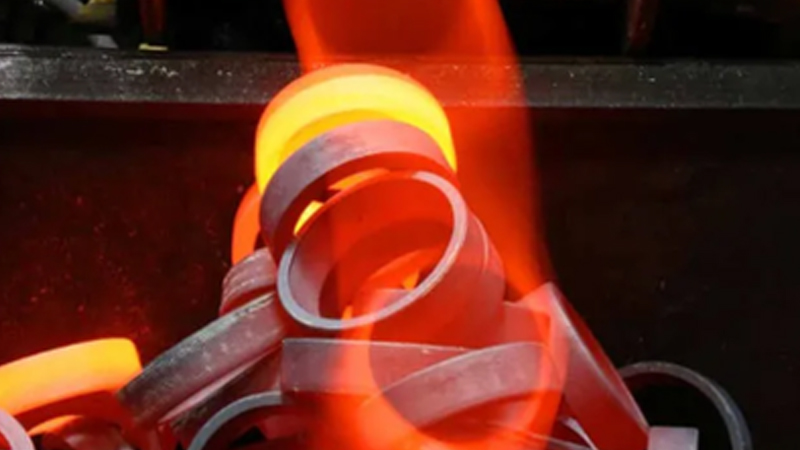
1. Annealing
Purpose: Eliminate processing stress, improve cutting performance, and adjust the uniformity of the microstructure.
Applicable stage: Before processing of bearing blanks (such as forgings and castings).
Process types:
Full annealing: Heat steel to 30-50°C above Ac3, hold, and then cool slowly to obtain a pearlite structure, reducing hardness for easier subsequent processing.
Spheroidizing annealing: For high-carbon chromium bearing steel (such as GCr15), heat to 20-30°C above Ac1, hold, and then cool slowly to spheroidize carbides, improving cutting performance and preparing for quenching.
2. Normalizing
Purpose: Refine grains, eliminate network carbides, and improve microstructure uniformity.
Applicable scenarios: Pre-treatment of medium-carbon steel or low-alloy steel bearing parts.
Process characteristics: Heat to 30-50°C above Ac3 or Accm, hold, and then air cool to obtain fine lamellar pearlite structure, with hardness slightly higher than annealing.
3. Quenching
Purpose: Obtain high-hardness martensitic structure to enhance wear resistance and fatigue resistance.
Key parameters:
Heating temperature: Usually 30-50°C above Ac1.
Cooling medium: Oil (such as mineral oil, quick oil), water-based solution, or high-pressure gas quenching (depending on material and part size).
Microstructure transformation: After austenitization, rapid cooling forms fine martensite + a small amount of retained austenite + carbides.
Precautions:
Quenching crack risk: Control heating temperature and cooling rate to avoid stress concentration.
Control of retained austenite: Further transform retained austenite through deep cryogenic treatment (-70°C or below) to improve dimensional stability.
4. Tempering
Purpose: Eliminate quenching stress, adjust the balance of hardness and toughness, and stabilize dimensions.
Process classification:
Low-temperature tempering (150-250°C): Used for rolling bearings to obtain high hardness (HRC 60-65) and wear resistance while reducing brittleness.
Medium-temperature tempering (350-500°C): Used for bearing parts subject to impact, such as cages, to improve elastic limit and toughness.
High-temperature tempering (500-650°C): Used for quenching and tempering treatment to achieve comprehensive mechanical properties (such as rings, shafts, etc.).
Microstructure change: Martensite decomposes into tempered martensite or tempered sorbite, and retained austenite decreases.
5. Special heat treatment processes
Surface strengthening treatment
Induction hardening: High-frequency induction heating of the raceway of bearing rings, followed by rapid cooling to form a high-hardness surface layer (HRC 60-62), while the core remains tough.
Carburizing/nitriding: For low-carbon steel bearings, carburizing (surface carbon content 0.8%-1.2%) or nitriding (forming a nitride layer) to improve surface hardness and wear resistance.
Selection basis for heat treatment processes
Material type: High-carbon chromium bearing steel commonly uses quenching + low-temperature tempering; carburizing steel requires carburizing + quenching + low-temperature tempering.
Performance requirements: High wear resistance selects quenching + low-temperature tempering; high toughness selects medium-temperature tempering; comprehensive performance selects high-temperature tempering.
Operating environment: In high-temperature, corrosive, or heavy-load conditions, surface strengthening treatment should be combined.
Summary
The heat treatment of bearings is a combination of quenching + tempering as the core, along with pre-treatment such as annealing and normalizing, and special processes like surface strengthening. By precisely controlling temperature, time, and cooling medium, a balance of hardness, toughness, wear resistance, and dimensional stability can be achieved to meet performance requirements under different operating conditions.


